
Certified Financial Analyst (CFA)
Driving Financial Insight, Investment Excellence, and Strategic Value Creation
The Professional Diploma in Certified Financial Analyst (CFA) from Washington Global University delivers globally recognized, practice-based training in financial analysis, investment management, and portfolio strategy.
This program bridges the gap between analytical precision, strategic decision-making, and ethical financial leadership—empowering professionals to interpret complex financial data, assess investment opportunities, and optimize capital allocation for sustainable growth. Participants develop the expertise to perform advanced valuation, risk assessment, and performance measurement that drive superior investment outcomes and strategic financial insight.
Through a blend of international finance standards, real-world case applications, and ethical investment principles, the CFA diploma equips participants to navigate global markets, craft data-driven financial strategies, and contribute meaningfully to enterprise value creation and long-term economic resilience in an ever-evolving financial landscape.
The Certified Financial Analyst (CFA) Professional Diploma from Washington Global University
The Certified Financial Analyst (CFA) Professional Diploma from Washington Global University is a rigorous, globally recognized program designed to develop advanced expertise in financial analysis, investment management, and strategic decision-making. Rooted in international financial standards and real-world market practices, the program prepares professionals to evaluate investments, manage portfolios, and drive sustainable financial performance in an increasingly dynamic global economy.
Balancing analytical theory with applied investment scenarios, the curriculum delivers comprehensive knowledge in equity and fixed-income analysis, corporate finance, derivatives, portfolio management, and ethical investment principles. Participants gain hands-on experience through financial modeling, valuation simulations, and case-based learning that cultivate the quantitative and strategic skills essential to world-class financial analysts.
Through in-depth study of market dynamics, risk management frameworks, and data-driven forecasting, students learn to interpret complex financial data, assess economic trends, and provide actionable insights that enhance capital efficiency and enterprise value. The program also explores emerging fields such as fintech innovation, sustainable finance, and behavioral investing—ensuring graduates remain ahead in a rapidly evolving financial landscape.
Graduates of the CFA Diploma are equipped for leadership roles such as Investment Analyst, Portfolio Manager, Financial Strategist, Equity Research Specialist, or Corporate Finance Advisor. They emerge as trusted professionals capable of shaping financial strategy, optimizing investment performance, and fostering long-term value creation.
Analyze with Precision. Invest with Insight. Lead with Financial Excellence.
Join Washington Global University and gain the professional distinction, analytical mastery, and ethical foundation to excel as a Certified Financial Analyst in today’s competitive global markets.
Featured Certified Financial Analyst (CFA) Courses
Objective:
Developing strategic expertise in asset allocation, portfolio construction, and investment performance evaluation to optimize returns while managing risk in dynamic market environments.
Ideal for:
Investment analysts, portfolio managers, wealth advisors, and finance professionals seeking to advance their investment management and asset strategy skills.
Specializations Include:
- Asset Allocation and Portfolio Strategy
- Equity and Fixed-Income Analysis
- Alternative Investments and Hedge Funds
- Risk and Return Optimization Techniques
- Performance Evaluation and Benchmarking
Learning Outcomes:
- Design diversified portfolios aligned with investor objectives and risk profiles.
- Apply modern portfolio theory and performance measurement frameworks.
- Evaluate global investment opportunities using quantitative and qualitative methods.
- Integrate ethical and sustainable investing principles into portfolio strategies.
Objective:
Equipping professionals with the knowledge to make high-impact financial decisions that enhance corporate value, capital efficiency, and long-term profitability.
Ideal for:
Corporate finance analysts, financial managers, business consultants, and executives focused on strategic financial planning and valuation.
Specializations Include:
- Financial Planning and Capital Budgeting
- Business Valuation and Mergers & Acquisitions
- Working Capital and Liquidity Management
- Capital Structure and Cost of Capital Optimization
- Strategic Decision-Making in Finance
Learning Outcomes:
- Conduct advanced valuation and capital budgeting analyses.
- Develop strategies to optimize corporate funding and investment structures.
- Interpret financial data to guide executive decision-making.
- Strengthen organizational value creation and shareholder returns.
Objective:
Building the ability to identify, measure, and manage market, credit, and operational risks through the effective use of derivatives and hedging techniques.
Ideal for:
Risk analysts, treasury specialists, investment bankers, and financial strategists involved in risk mitigation and asset protection.
Specializations Include:
- Market and Credit Risk Analysis
- Derivatives Instruments and Hedging Strategies
- Financial Modeling for Risk Assessment
- Quantitative Methods and Value at Risk (VaR)
- Treasury Operations and Risk Reporting
Learning Outcomes:
- Apply derivatives and structured products to mitigate financial risk.
- Conduct quantitative risk modeling using industry-standard tools.
- Evaluate financial exposure and implement effective hedging techniques.
- Strengthen institutional resilience through proactive risk management.
Objective:
Harnessing the power of data analytics and financial modeling to generate actionable insights, forecast trends, and support investment and corporate finance decisions.
Ideal for:
Financial analysts, data specialists, valuation experts, and finance professionals seeking to integrate analytics into strategic decision-making.
Specializations Include:
- Financial Modeling with Excel and Python
- Forecasting and Predictive Analytics
- Business Valuation Techniques
- Quantitative Analysis and Data Visualization
- Scenario Analysis and Sensitivity Testing
Learning Outcomes:
- Build dynamic financial models for valuation and forecasting.
- Analyze financial data to identify patterns and opportunities.
- Translate quantitative findings into strategic business insights.
- Utilize analytics tools to enhance investment and financial decision accuracy.
Objective:
Developing a deep understanding of environmental, social, and governance (ESG) principles to guide ethical investment decisions and promote sustainable financial practices.
Ideal for:
Investment professionals, sustainability officers, corporate strategists, and financial advisors committed to responsible investing.
Specializations Include:
- ESG and Sustainable Investment Principles
- Ethical Decision-Making in Finance
- Social Impact and Green Finance Instruments
- Corporate Sustainability Reporting and Disclosure
- Global Regulatory Frameworks for Sustainable Finance
Learning Outcomes:
- Integrate ESG factors into investment and financial strategies.
- Evaluate the impact of sustainability on portfolio performance.
- Promote ethical leadership and responsible finance.
- Drive long-term value creation through sustainable investment practices.
Developing Leaders to Transform Financial Insight into Strategic Value Creation
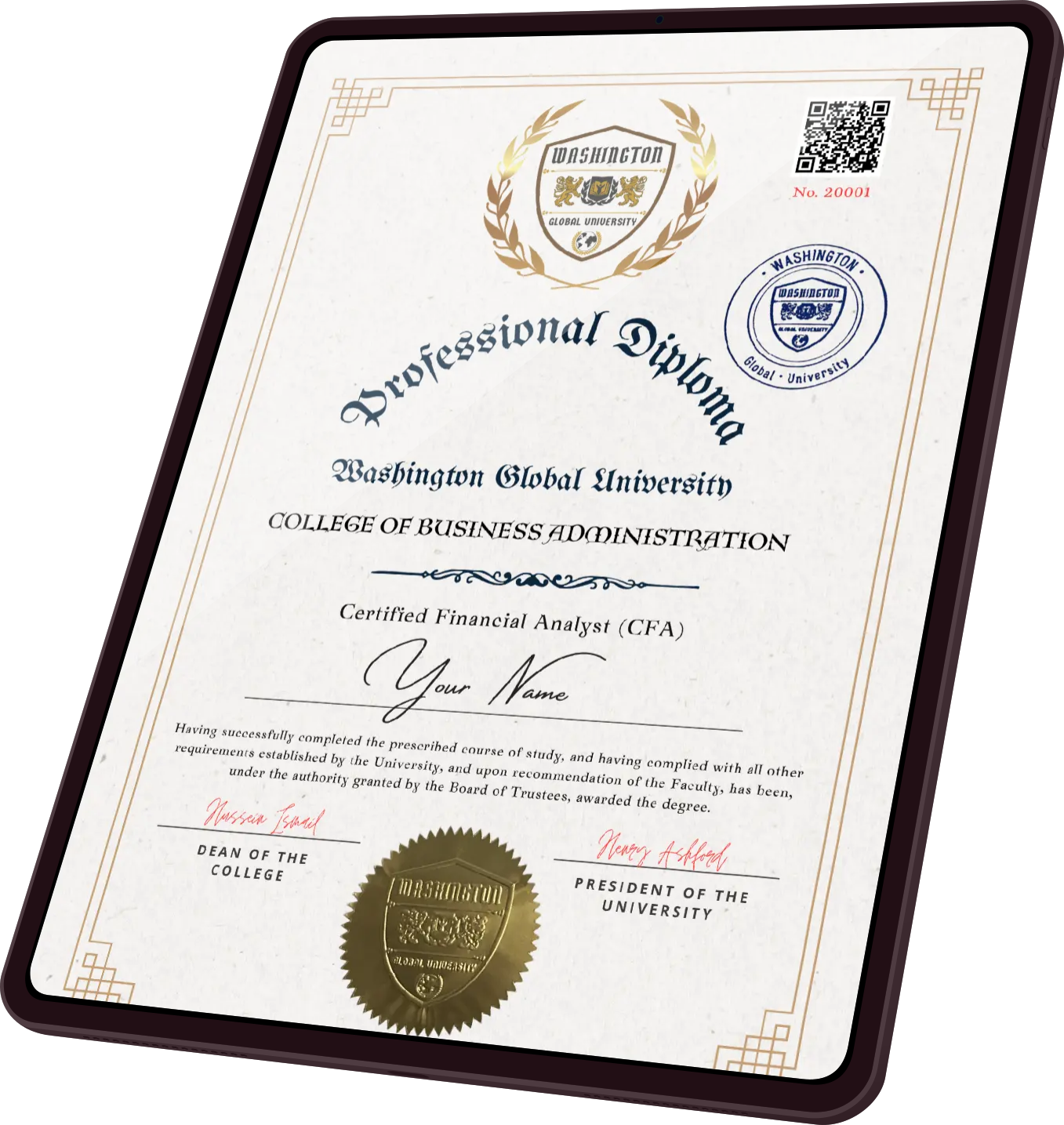
Earn a Certified Financial Analyst (CFA) Degree
Advance your expertise in global finance with a Certified Financial Analyst (CFA) degree from Washington Global University, a certified institution accredited by the Federal Commonwealth, the U.S. Department of State, and approved by the student’s embassy for international recognition. To ensure transparency and confidence, students may secure funds through www.escrow.com until verified copies of the official certificates and accreditation documents are safely delivered. This guarantees a trusted, accredited, and globally respected qualification designed to strengthen your professional standing in the world of financial analysis and investment management.
Empowering Professionals for Financial Strategy, Investment, and Analytical Excellence
The Certified Financial Analyst (CFA) Professional Diploma from Washington Global University is a globally respected, practice-oriented program designed to cultivate advanced expertise in investment management, financial analysis, and portfolio strategy.
This comprehensive program equips professionals with the analytical, ethical, and decision-making skills required to evaluate financial markets, manage investment portfolios, and drive sustainable financial growth. Participants gain practical experience in financial modeling, securities valuation, risk assessment, and strategic asset allocation—preparing them to excel in competitive global financial environments.
By integrating international finance principles with real-world investment applications, the CFA Diploma empowers professionals to lead with confidence, optimize financial performance, and uphold the highest standards of integrity in the dynamic world of global finance.
Who Should Attend?
This program is ideal for:
- Finance professionals seeking to enhance their analytical and investment management capabilities.
- Accountants, auditors, and economists aspiring to transition into financial analysis or investment roles.
- Banking and finance executives aiming to strengthen strategic decision-making and portfolio management skills.
- Recent graduates in finance, business, or economics looking to build a strong foundation for a career in financial analysis or investment management.
Why Join This Program?
By enrolling in the Certified Financial Analyst (CFA) Diploma, participants will:
- Gain an internationally recognized credential from Washington Global University.
- Develop expertise in financial modeling, valuation techniques, and risk assessment.
- Enhance strategic thinking and decision-making in investment and corporate finance.
- Strengthen professional credibility and open global career opportunities in finance and investment sectors.
- Join a network of global financial professionals and alumni for ongoing professional development.
Each Choice You Make Today Shapes the Success You’ll Celebrate Tomorrow!
5 Modul - 20 Part –Certified Financial Analyst (CFA)-30 Hours
Module 1: Foundations of Financial Analysis and Markets (6 Hours)
Objective:
Build a strong foundation in financial principles, market operations, and analytical frameworks essential for professional financial analysis.
-
Part 1: Introduction to Financial Analysis and the Role of the CFA (1.5 hrs)
Understand the function and significance of financial analysts in global financial markets. -
Part 2: Structure and Functioning of Financial Markets (1.5 hrs)
Explore capital markets, money markets, and the roles of financial intermediaries. -
Part 3: Financial Instruments and Asset Classes (1.5 hrs)
Examine equities, fixed income, derivatives, and alternative investments. -
Part 4: Economic Principles for Financial Analysts (1.5 hrs)
Analyze the impact of macroeconomic and microeconomic factors on financial decision-making.
Module 2: Financial Reporting and Statement Analysis (6 Hours)
Objective:
Develop expertise in interpreting, analyzing, and evaluating financial statements to assess company performance and value.
-
Part 1: Principles of Financial Reporting and IFRS Standards (1.5 hrs)
Review global accounting standards and their implications for financial analysis. -
Part 2: Income Statement and Balance Sheet Analysis (1.5 hrs)
Learn to evaluate profitability, liquidity, and solvency through key financial metrics. -
Part 3: Cash Flow Statement Analysis (1.5 hrs)
Understand the importance of cash flow in assessing operational efficiency and sustainability. -
Part 4: Ratio Analysis and Financial Performance Evaluation (1.5 hrs)
Apply analytical tools to interpret financial ratios and benchmark organizational performance.
Module 3: Investment Analysis and Portfolio Management (6 Hours)
Objective:
Gain practical knowledge of investment vehicles, valuation models, and portfolio construction techniques to optimize risk-return outcomes.
-
Part 1: Fundamentals of Investment and Risk-Return Concepts (1.5 hrs)
Understand risk measurement, diversification, and expected return. -
Part 2: Equity and Fixed Income Valuation Techniques (1.5 hrs)
Learn key valuation models, including DCF, dividend discount, and bond pricing. -
Part 3: Portfolio Theory and Asset Allocation (1.5 hrs)
Apply modern portfolio theory and strategic asset allocation principles. -
Part 4: Performance Measurement and Benchmarking (1.5 hrs)
Evaluate investment performance using alpha, beta, Sharpe ratio, and benchmark indices.
Module 4: Corporate Finance and Financial Decision-Making (6 Hours)
Objective:
Understand the strategic financial decisions that drive corporate value creation and sustainability.
-
Part 1: Time Value of Money and Capital Budgeting (1.5 hrs)
Apply NPV, IRR, and payback analysis to investment decision-making. -
Part 2: Cost of Capital and Capital Structure (1.5 hrs)
Examine the impact of financing decisions on firm value and risk. -
Part 3: Dividend Policy and Working Capital Management (1.5 hrs)
Analyze dividend strategies and liquidity management in corporate finance. -
Part 4: Mergers, Acquisitions, and Corporate Restructuring (1.5 hrs)
Explore valuation, integration, and risk considerations in M&A transactions.
Module 5: Ethics, Risk Management, and Global Financial Strategies (6 Hours)
Objective:
Integrate ethical principles, risk management frameworks, and global perspectives into professional financial analysis and strategy.
-
Part 1: Ethical and Professional Standards in Financial Analysis (1.5 hrs)
Study the CFA Code of Ethics and apply integrity in financial decision-making. -
Part 2: Financial Risk Management and Derivatives (1.5 hrs)
Identify and manage market, credit, and operational risks using financial instruments. -
Part 3: International Finance and Global Markets (1.5 hrs)
Understand exchange rates, international investments, and global capital flows. -
Part 4: Strategic Financial Planning and Future Trends (1.5 hrs)
Examine digital finance, fintech innovations, and sustainable investment strategies.
Fostering Global Standards of Excellence in Financial Analysis, Investment, and Strategic Decision-Making
✽ What We Offer
Tuition and Scholarships
We believe you can achieve your goals—and we are here to support you along your journey. Request information to learn more about scholarships and financial aid for those who apply and qualify.
A dedicated student portal
Your all-in-one online hub, designed to keep every academic detail at your fingertips.
Record of Completed Courses
Track your learning journey with a clear overview of all courses you’ve successfully completed.
Academic Transcript
Access an official, up-to-date record of your grades and achievements at every stage.
Accredited Certified Diploma
Graduate with a globally recognized certificate that validates your hard work and success.
Certificate Samples
View sample certificates directly on your student page, giving you a preview of your official credentials.
Accredited Credentials
Why it matters: Having a document notarized makes it more trustworthy and helps prevent fraud, since the notary’s stamp and signature confirm the identity and intent of the signer.
Shape Your Future with a Credential that Builds Expertise, Ethical Judgment, and Market Intelligence

Notary Public in the United States
A Notary verifies identity , ensures free consent, and certifies valid execution of certificates and documents.
Discover more
Federal Commonwealth Authentication
The Secretary of State’s office verifies that the document was properly notarized or issued by an authorized public official (such as a notary public, county clerk, or registrar). This confirms the document’s legitimacy before it is used abroad.

U.S. Department of State
A signature shows intent, but authentication by the Secretary of State gives your documents unquestionable credibility—transforming personal agreements into legally recognized records trusted at home and abroad.
Continue reading
Embassies & Consulates (if required)
After a document is notarized, authenticated by the Secretary of State, and (if necessary) approved by the U.S. Department of State, the foreign embassy or consulate provides the final legalization. This confirms to the receiving country that the document has been properly verified by all U.S. authorities.
The applicant for the Specialized Certified Diploma receives
University Admission Letter
Official confirmation of acceptance into the specialized Certified Diploma program.
Accreditation Authority Report
A document verifying that the program meets academic accreditation standards.
Scholarship Certificates
Proof of awarded academic scholarships supporting the student’s study.
Certificates of Excellence and Academic Achievement
Recognition of outstanding performance and scholarly accomplishments.
Scientific Competency Report
An evaluation confirming the applicant’s readiness and qualification for the program.
Scientific Verification Certificate
A document validating the authenticity of the applicant’s academic credentials.
Specialization Course Transcript
detailed record of the courses and subjects covered in the chosen major.
Scientific Membership Card
Identification confirming the applicant’s membership in the academic body.
Scholarship Package in Arabic
A full set of scholarship certificates issued in Arabic for additional recognition
Registration Procedures for Obtaining the Certified Financial Analyst (CFA)
Basic Steps for Enrollment at Washington Global University in the United States
- No application fee
- You are 21 years of age or older.
- Complete the application form with your personal and academic information.
- Upload a copy of your educational qualification
- Upload a valid proof of identity (Passport – National ID Card – Personal Identification Document).
- Once your application is reviewed, you will be contacted via email.
- An online interview or a written test may be required.
- Receive the official admission letter.
- Pay the tuition fees (either in full or partially, depending on the plan).
- Obtain your login credentials for the online learning platform.
Work one-on-one with an Enrollment Specialist who’ll guide you through every step—from choosing the right program to paying for your education.
- Attend online lectures (live or recorded).
- Submit assignments through the platform.
- Participate in online forums and virtual discussions.
Invest in the You of Tomorrow – Start with a Decision Today!
Whatever your question is, we’ve got you covered
Whatever your question is, we’ve got you covered.
Washington Global University Enrollment Specialists are trained to help you research, plan, and get started on your academic journey.
Our latest content
Check out what's new in our company !
Discover Your Future — Explore Accredited Degrees Today!
Unlock your global potential with Washington Global University’s fully accredited, embassy-approved degrees—explore your future today!