
Master of Healthcare Administration (MHA)
Become a Problem-Solving Force With Our MBA Healthcare Management Specialization
More than ever, the healthcare industry needs bold, innovative change-makers. In this specialization, you’ll acquire the leadership and analytical skills required to identify opportunities; address challenges; and deliver better, more affordable, and more equitable patient care. Gain a greater understanding of the U.S. healthcare system and the financial management techniques that fuel successful healthcare organizations. Learn to build and lead diverse teams and create positive change in your workplace and community.
Lead the Future of Healthcare With Our Master of Healthcare Administration (MHA)
In this program, you’ll gain the advanced leadership, management, and analytical skills required to navigate the complex and rapidly evolving world of healthcare. Develop the strategic mindset and organizational insight needed to improve patient outcomes, optimize healthcare systems, and lead teams with confidence.
Through this MHA program, you’ll explore essential areas such as healthcare operations, policy, finance, and quality management—while mastering critical soft skills like communication, ethical decision-making, and crisis leadership. Whether your goal is to manage hospitals, clinics, or healthcare networks, this degree prepares you to become an innovative leader driving excellence and transformation in modern healthcare organization
Take a Closer Look
Discover what it’s like to earn your MBA – Healthcare Management specialization online at Washington Global University, from our transfer-of-credit policy to our engaging curriculum.In our online MHA program, you’ll deepen your knowledge of financial operations, management, and human resources and explore the trends, regulations, laws, and policies impacting health systems and healthcare organizations today.
Featured MHA Online Courses
In this course, students gain contemporary knowledge of financial and economic principles such as efficiency and value as it relates to health care. The principles of health care financial management, including accounting and finance, are vitally important to the viability and ongoing operations of a healthcare entity. Students have the opportunity to interpret and analyze the financial statements, use and analyze financial ratios, utilize variance analysis, understand and implement operating and capital budgeting, and develop knowledge of the business planning process. Students create portions of a business/financial plan and assess the viability of their plan using accepted financial management tools.
The challenges of the changing healthcare environment from a volume-based to a value-based focus require healthcare administrators to examine forces that affect organization business and operational performance and patient care outcomes. In this course, students examine the forces and trends that affect performance outcomes within healthcare organizations and analyze how high reliability healthcare organizations model and implement sustainable operations management practices. Students assess and apply how changes in healthcare organization structure, logistics, and supply chains can result in positive patient care outcomes and explore evidence-based management practice models to promote and implement performance excellence standards in various healthcare settings.
The rapidly evolving health care system presents the health care administrator with complex challenges and risks. Health care administrators must possess the skills needed to assess federal, state, and local health care policies that frame the delivery of health care services. In this course, students assess and discuss key legal and ethical initiatives from diverse perspectives. Course work focuses on required knowledge of health care laws, policies, and regulations enacted by policymakers and regulatory agencies that impact health care. This also includes comprehensive health care reform issues impacting and influencing the role of the health care administrator. To help frame these concepts, students examine and analyze the ethical underpinnings and principles that health care organizations and administrators observe and follow in the delivery of services to patients.
Students in this course are introduced to the basis for quality and patient safety and are provided an overview of healthcare quality, methods of assessing quality, and techniques for improving quality. They can learn key terminology and concepts, including defining quality care; measuring quality in terms of the structure-process-outcomes model; distinguishing between clinical and customer service quality; identifying techniques to avoid adverse clinical events; and exploring customer service quality in terms of defining, measuring, and improving patient satisfaction. Students also explore and discuss the roles of governmental agencies in promoting and reporting quality information regarding hospitals and other health organizations, accrediting bodies, and recent performance initiatives of government and private payers. They apply course concepts to current issues of improving clinical and service quality in healthcare organizations, with special consideration of the 5 Million Lives Campaign—a national effort initiated by the Institute for Healthcare Improvement designed to improve medical care in the United States.
In this course, students investigate and analyze the changing landscape of the health care environment and the factors affecting leadership in health care administration. Students consider stakeholders in a variety of settings to establish a framework for scholarly investigation of effective strategies for healthcare administrators in practice. Particular emphasis will include the importance of collaboration, critical thinking, communication, and diversity. Strategies include professional leadership behaviors that enable effective positive social change, such as setting goals and managing time, as well as the attitudes and motivation required for success as a healthcare manager, administrator, and leader. Students create an individualized professional development plan and develop the core competencies needed for success within an online learning environment.
We believe you can achieve your goals—and we are here to support you along your journey
Master of Healthcare Administration (MHA)
The Master of Healthcare Administration (MHA) is an advanced graduate program designed to develop the strategic, analytical, and leadership expertise required to manage and transform healthcare organizations in today’s complex and rapidly evolving environment. This program prepares learners to lead with confidence, drive operational excellence, and implement effective policies that enhance the quality and efficiency of healthcare delivery.
The MHA program provides students with a comprehensive understanding of healthcare systems, finance, policy, operations, and quality management. Through a combination of evidence-based theory and real-world application, students learn to analyze data, manage resources, and make informed decisions that improve patient outcomes and organizational performance. Graduates emerge as ethical and innovative healthcare leaders—ready to shape policy, guide multidisciplinary teams, and advance the future of healthcare administration across diverse settings.
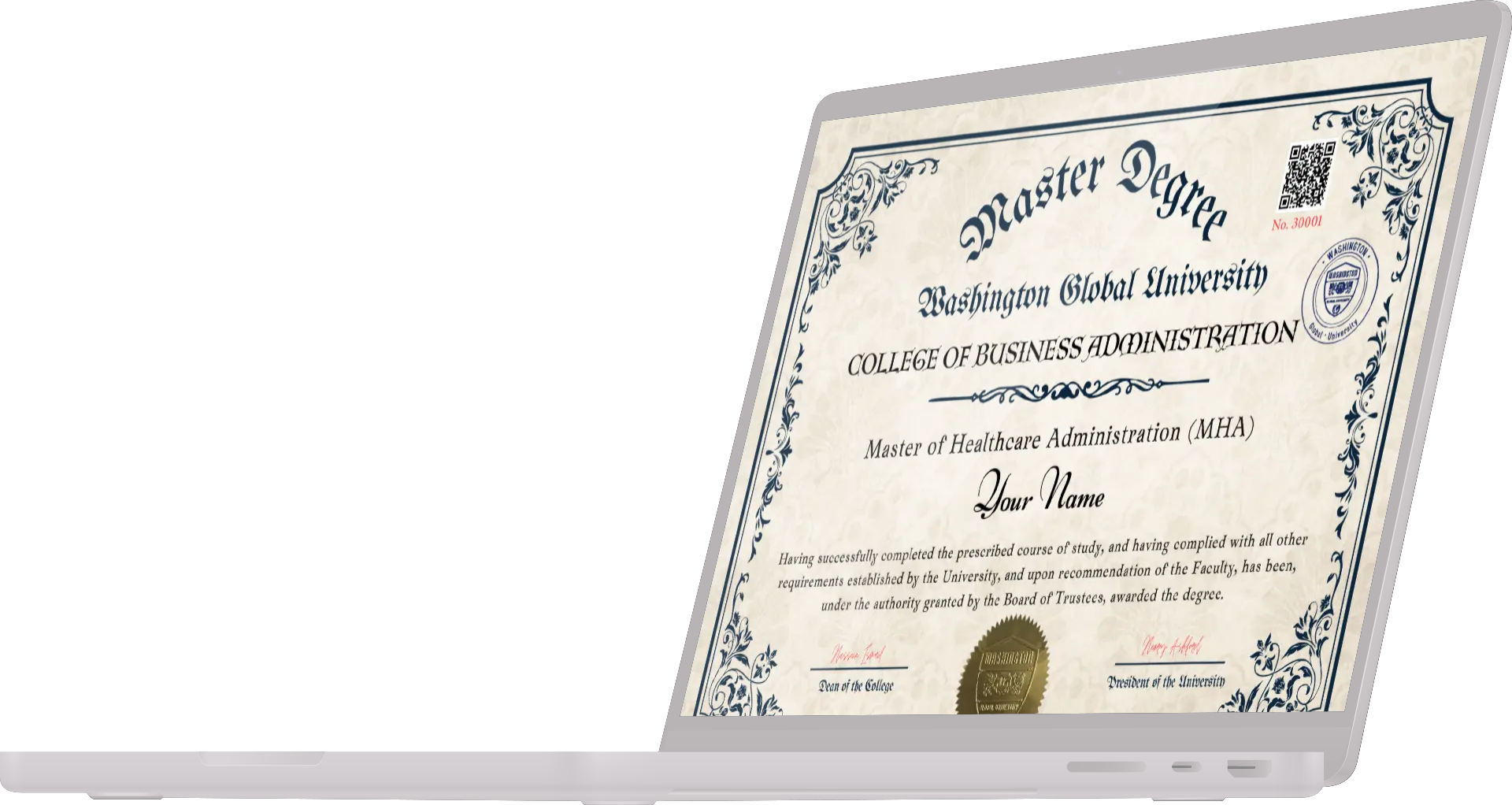
Earn a Certified Master of Healthcare Administration (MHA)
Advance your leadership in the healthcare industry with a Master of Healthcare Administration (MHA) from Washington Global University, a fully certified institution accredited by the Federal Commonwealth, the U.S. Department of State, and approved by the student’s embassy for international recognition. To ensure transparency and confidence, students may provide a financial guarantee through www.escrow.com until verified copies of official certificates and accreditation documents are securely delivered. This guarantees a credible, accredited, and globally respected qualification designed to elevate your healthcare management career.
5 Modul - 20 Part – Master of Healthcare Administration (MHA) -100 Hours
Module 1: Foundations of Healthcare Administration (20 Hours)
Establishes a scientific and strategic understanding of healthcare systems, management principles, and leadership in complex health environments.
Part 1: Healthcare Systems and Organizational Structures – 5 hrs
- Global and national healthcare models, system design, and public–private partnerships.
Part 2: Principles of Healthcare Management and Leadership – 5 hrs
- Management science, leadership theory, and administrative functions in healthcare.
Part 3: Healthcare Policy, Governance, and Reform – 5 hrs
- Policy analysis, healthcare reform trends, and the role of government and regulation.
Part 4: Strategic Planning and Change Management in Healthcare – 5 hrs
- Evidence-based strategic frameworks and innovation management in healthcare organizations.
Module 2: Healthcare Finance (20 Hours)
Focuses on the analytical and fiscal tools required to manage healthcare resources efficiently and sustainably.
Part 1: Fundamentals of Healthcare Economics – 5 hrs
- Economic principles, market behavior, and cost structures in healthcare systems.
Part 2: Financial Management and Budgeting in Healthcare – 5 hrs
- Budget development, forecasting, cost–benefit analysis, and financial performance metrics.
Part 3: Healthcare Reimbursement and Revenue Cycle Management – 5 hrs
- Insurance systems, Medicare/Medicaid, billing cycles, and financial compliance.
Part 4: Capital Investment and Risk Management – 5 hrs
- Evaluating capital projects, financial risk mitigation, and investment strategies in healthcare.
Module 3: Healthcare Operations (20 Hours)
Explores scientific management methods to enhance efficiency, productivity, and patient-centered care delivery.
Part 1: Operations Management in Healthcare Systems – 5 hrs
- Workflow optimization, process mapping, and systems efficiency models.
Part 2: Healthcare Supply Chain and Resource Management – 5 hrs
- Inventory control, procurement, logistics, and technology integration in hospitals.
Part 3: Data Analytics and Decision Support Systems – 5 hrs
- Using data science and informatics for evidence-based operational decisions.
Part 4: Human Capital and Workforce Management in Healthcare – 5 hrs
- Staffing models, leadership development, and team dynamics in healthcare environments.
Module 4: Law and Ethics in Healthcare (20 Hours)
Develops a strong foundation in healthcare law, ethics, and governance to promote accountability and compliance.
Part 1: Healthcare Law and Policy Frameworks – 5 hrs
- Legal structures, patient rights, and the regulatory environment in healthcare.
Part 2: Ethical Decision-Making in Healthcare Leadership – 5 hrs
- Bioethics, moral reasoning, and ethical dilemmas in patient care and administration.
Part 3: Risk Management and Legal Compliance – 5 hrs
- Liability, malpractice prevention, and institutional risk assessment.
Part 4: Public Health Ethics and Social Responsibility – 5 hrs
- Equity, access to care, and ethical leadership in public health initiatives.
Module 5: Healthcare Quality Management (20 Hours)
Applies scientific and analytical approaches to improve care quality, safety, and organizational performance.
Part 1: Principles of Quality Improvement and Patient Safety – 5 hrs
- Lean, Six Sigma, and Total Quality Management (TQM) in healthcare systems.
Part 2: Performance Measurement and Outcome Evaluation – 5 hrs
- Quality indicators, benchmarking, and outcome-based healthcare delivery.
Part 3: Evidence-Based Practice and Clinical Effectiveness – 5 hrs
- Research translation, evidence-based policy, and continuous improvement systems.
Part 4: Accreditation, Compliance, and Continuous Quality Assurance – 5 hrs
- Regulatory bodies, accreditation processes, and maintaining organizational standards.
Success Starts with a Single Choice – Make That Choice Today!
✽ What We Offer
Tuition and Scholarships
We believe you can achieve your goals—and we are here to support you along your journey. Request information to learn more about scholarships and financial aid for those who apply and qualify.
A dedicated student portal
Your all-in-one online hub, designed to keep every academic detail at your fingertips.
Record of Completed Courses
Track your learning journey with a clear overview of all courses you’ve successfully completed.
Academic Transcript
Access an official, up-to-date record of your grades and achievements at every stage.
Accredited Master's Degree Certificate
Graduate with a globally recognized certificate that validates your hard work and success.
Certificate Samples
View sample certificates directly on your student page, giving you a preview of your official credentials.
Accredited Credentials
Why it matters: Having a document notarized makes it more trustworthy and helps prevent fraud, since the notary’s stamp and signature confirm the identity and intent of the signer.
Unlock Accredited Credentials That Open Doors to Opportunity

Notary Public in the United States
A Notary verifies identity , ensures free consent, and certifies valid execution of certificates and documents.
Discover more
Federal Commonwealth Authentication
The Secretary of State’s office verifies that the document was properly notarized or issued by an authorized public official (such as a notary public, county clerk, or registrar). This confirms the document’s legitimacy before it is used abroad.

U.S. Department of State
A signature shows intent, but authentication by the Secretary of State gives your documents unquestionable credibility—transforming personal agreements into legally recognized records trusted at home and abroad.
Continue reading
Embassies & Consulates (if required)
Accreditation is granted through Washington Global University. Once the relevant document has been duly notarized and issued with a U.S. Apostille by the competent U.S. authority, the holder may present it for official use in their home country, provided that the country is a Contracting Party to the 1961 Hague Apostille Convention. Under Articles 2 and 3 of the Convention, the U.S. Apostille replaces the traditional diplomatic or consular legalization process; therefore, an additional Apostille from the holder’s home country is generally not required.
The applicant for the Specialized Master's Degree receives a scholarship package, which includes:
University Admission Letter
Official confirmation of acceptance into the specialized Master's program.
Accreditation Authority Report
A document verifying that the program meets academic accreditation standards.
Scholarship Certificates
Proof of awarded academic scholarships supporting the student’s study.
Certificates of Excellence and Academic Achievement
Recognition of outstanding performance and scholarly accomplishments.
Scientific Competency Report
An evaluation confirming the applicant’s readiness and qualification for the program.
Scientific Verification Certificate
A document validating the authenticity of the applicant’s academic credentials.
Specialization Course Transcript
detailed record of the courses and subjects covered in the chosen major.
Scientific Membership Card
Identification confirming the applicant’s membership in the academic body.
Scholarship Package in Arabic
A full set of scholarship certificates issued in Arabic for additional recognition
Registration Procedures for the Master's degree in Master of Healthcare Administration (MHA)
Basic Steps for Enrollment at Washington Global University in the United States
- No application fee
- You are 21 years of age or older.
- Complete the application form with your personal and academic information.
- Upload a copy of your educational qualification: Accredited Bachelor's Degree
- Upload a valid proof of identity (Passport – National ID Card – Personal Identification Document).
- Once your application is reviewed, you will be contacted via email.
- An online interview or a written test may be required.
- Receive the official admission letter.
- Pay the tuition fees (either in full or partially, depending on the plan).
- Obtain your login credentials for the online learning platform.
Work one-on-one with an Enrollment Specialist who’ll guide you through every step—from choosing the right program to paying for your education.
- Attend online lectures (live or recorded).
- Submit assignments through the platform.
- Participate in online forums and virtual discussions.
Success Starts with a Single Choice – Make That Choice Today!
Whatever your question is, we’ve got you covered
Whatever your question is, we’ve got you covered.
Washington Global University Enrollment Specialists are trained to help you research, plan, and get started on your academic journey.
Our latest content
Check out what's new in our company !
Discover Your Future — Explore Accredited Degrees Today!
Unlock your global potential with Washington Global University’s fully accredited, embassy-approved degrees—explore your future today!