BS in Healthcare Management
Discover a flexible path to your BS in Healthcare Management degree.
You want to do more than build a bright future for yourself—you want to improve healthcare for all. Washington Global University BS in Healthcare Management online program can empower you to do both. Explore the biggest challenges facing the industry today and the complexities of providing equitable, accessible care to diverse populations. Build the skills and insights to help healthcare organizations drive sustainable improvements in service quality, safety, and delivery.
Bachelor of Science (BS) in Healthcare Management
Lead with Compassion. Manage with Purpose. Transform Healthcare Delivery.
The Bachelor of Science (BS) in Healthcare Management at Washington Global University is designed to prepare future leaders who can navigate the dynamic and evolving landscape of healthcare systems with strategic insight, ethical integrity, and organizational excellence. This program blends foundational knowledge in healthcare operations, policy, and finance with essential management, communication, and leadership skills—empowering students to make a lasting impact on the quality and efficiency of patient care.
Students gain a strong understanding of healthcare administration, health information systems, public health principles, and organizational behavior. Through applied learning and real-world case studies, learners develop the ability to lead multidisciplinary teams, analyze healthcare trends, and implement effective strategies that improve patient outcomes and organizational performance.
Graduates are equipped to pursue diverse roles in hospitals, clinics, insurance organizations, public health agencies, and healthcare corporations. Whether your goal is to manage healthcare operations, shape policy, or innovate patient care delivery, the BS in Healthcare Management provides the comprehensive education and professional foundation to lead with confidence in one of the world’s fastest-growing and most vital industries.
Bachelor of Science (BS) in Healthcare Management
Lead with Compassion. Manage with Purpose. Transform Healthcare Delivery.
The Bachelor of Science in Healthcare Management (BS in HM) at Washington Global University is an innovative undergraduate program designed to prepare future healthcare leaders to meet the challenges of an evolving global health environment. This program combines management theory, public health policy, and healthcare operations with ethical decision-making and strategic leadership.
Students explore healthcare systems, finance, quality improvement, and data-driven decision-making while developing the communication and problem-solving skills essential for effective leadership. Through interactive coursework and applied projects, learners gain the tools to enhance patient care, streamline operations, and ensure organizational compliance in diverse healthcare settings.
Graduates emerge prepared for roles in hospital administration, healthcare consulting, insurance management, and public health organizations. Whether you aim to manage clinical operations or shape healthcare policy, the BS in Healthcare Management equips you to lead with excellence, integrity, and vision.
Bachelor of Science (BS) in Public Health
Empower Communities. Advance Health Equity. Create Lasting Change.
The Bachelor of Science in Public Health (BS in PH) at Washington Global University is designed for students passionate about improving population health and addressing global health challenges. This interdisciplinary program provides a solid foundation in epidemiology, biostatistics, environmental health, and health policy—equipping students to develop data-driven, culturally competent public health solutions.
Learners engage in evidence-based study of disease prevention, community health education, and global health systems while exploring ethical and policy dimensions of public health practice. Through hands-on projects and community-based research, students gain the analytical, leadership, and advocacy skills needed to promote wellness and equity on a local and global scale.
Graduates are prepared to pursue careers in public health administration, health education, epidemiology, and non-profit advocacy—or continue to graduate studies in public health and healthcare policy. The BS in Public Health empowers changemakers to protect and promote health across all communities.
Bachelor of Science (BS) in Health Communication
Inspire Understanding. Bridge Science and Society. Shape Health Narratives.
The Bachelor of Science in Health Communication (BS in HC) at Washington Global University is a forward-looking program that integrates communication theory, public health, and digital media to empower students to transform how health information is shared and understood.
Students explore how communication shapes health behaviors, influences policy, and drives public awareness. The program emphasizes strategic message design, media literacy, and campaign development, preparing graduates to convey complex health information clearly and compassionately across diverse audiences.
Through coursework in social marketing, intercultural communication, and digital storytelling, learners develop the ability to lead impactful health communication initiatives in healthcare organizations, government agencies, media outlets, and non-profits.
Graduates of the BS in Health Communication become influential communicators who promote health literacy, inspire behavior change, and advocate for evidence-based public health initiatives.
Bachelor of Science (BS) in Health Promotion and Wellness
Promote Wellness. Prevent Disease. Empower Healthy Living.
The Bachelor of Science in Health Promotion and Wellness (BS in HPW) at Washington Global University prepares students to lead in one of the fastest-growing sectors of healthcare—preventive health and wellness promotion. This program blends health science, psychology, and behavioral change theory to equip learners with the knowledge and practical tools to design, implement, and evaluate wellness programs.
Students study nutrition, fitness, stress management, and community health strategies while learning to address health disparities and motivate positive lifestyle changes. The curriculum emphasizes holistic well-being—focusing on physical, emotional, social, and environmental health.
Graduates are prepared to work in wellness coaching, community health programs, corporate wellness initiatives, and health education. Whether working in healthcare, education, or corporate settings, the BS in Health Promotion and Wellness empowers professionals to lead healthier lives and communities through knowledge, empathy, and innovation.
Curriculum and Completion Requirements
Choose the standard BS in Healthcare Management online track or our Accelerate Into Master’s (AIM) option. AIM allows you to earn credits toward a Washington Global University master’s degree program while completing your undergraduate studies.
The nature of health services, such as personal evaluations, clinical research, invasive surgeries, and end of life care, facilitates a host of ethical and legal considerations of which professionals must be aware. In this course, students examine the legal and ethical issues that are fundamental to the practice of healthcare and the conduct of health-related research. They explore a historical overview of events and milestones that have shaped the contemporary regulatory landscape. They also investigate and assess issues of privacy and confidentiality, informed consent, licensing, and malpractice, among others. Additionally, students consider ethical, decision-making models for assuring the quality, safety, and appropriateness of healthcare and services. They also apply ethical principles and legal considerations to real-world scenarios.
Students in this course describe the causes and consequences of historical events on health and medical care in the United States. They explain barriers related to cost, quality, and access to health and medical care. Students examine unique and complex aspects of subsystems and classify vertical and horizontal integrated healthcare delivery systems. They compare characteristics of healthcare in the U.S. with healthcare systems in other countries. Students also identify current and future issues, trends, and forces in healthcare reform.
The focus of this course is on the application and use of information technology to support clinical and managerial decision making in healthcare. Emphasis is placed on information technology that supports the delivery of services, including the collection, storage, retrieval, and communication of data; information systems safeguards; ethical and legal issues; and information management to promote patient safety and quality of care. Information literacy and basic hardware and software concepts are addressed. Fundamental software applications, including spreadsheets and healthcare databases, are considered.
In this course, students examine management concepts and theories designed to influence and improve the performance of healthcare organizations. They identify and examine the external and internal environments of organizations as well as key management functions, roles, and responsibilities. Exploring essential aspects of healthcare management, students engage in a variety of conceptual and practical activities, such as profiling a healthcare manger, assessing the value of leadership in decision making, and comparing strategic plans. Students delve deeper into content through weekly discussions on a variety of topics, such as emotional intelligence, applications of financial management, issues of quality and safety, the purpose of strategic planning, and challenges in human resources.
In the Health Communication concentration, you’ll build strong communication skills for healthcare and community applications. Learn to create compelling messages that resonate across diverse populations and explore the use of emerging technologies and social media in marketing and communications.
Gain the skills to advocate for healthier lifestyle choices in our Health Promotion and Wellness concentration. Explore the latest findings on prevention and wellness—and learn to use this knowledge to promote healthier individuals and communities.
Earn a Certified Bachelor of Science in Healthcare Management
Begin your journey toward leadership in the healthcare industry with a Bachelor of Science in Healthcare Management (BSHM) from Washington Global University, a certified institution accredited by the Federal Commonwealth, the U.S. Department of State, and approved by the student’s embassy for international recognition. To ensure complete transparency and trust, students have the option to provide a financial guarantee through www.escrow.com until verified copies of the official certificates and accreditation documents are securely delivered. This guarantees a credible, accredited, and globally respected degree designed to prepare future healthcare leaders for success in management and administration.
Earn Career-Focused Credentials With Immediate Impact
Manage with Purpose. Transform the Future of Healthcare.
The Bachelor of Science in Healthcare Management at Washington Global University prepares you to become a strategic leader in one of the world’s fastest-growing industries. This program explores how effective management, ethical decision-making, and innovation come together to enhance patient care, improve organizational performance, and strengthen community health systems.
Gain a deep understanding of healthcare operations, policy, and finance while developing the leadership and communication skills needed to guide multidisciplinary teams. Through practical learning and case-based study, you’ll learn how to manage change, optimize resources, and ensure quality care in hospitals, clinics, and health organizations.
Lead with integrity and shape the systems that shape lives—the future of healthcare leadership starts here.
Each Step Forward Moves You Closer to the Life You Deserve — Take That Step Now!
6 Modul - 24 Part – BS in Healthcare Management -100 Hours
Module 1: Foundations of Healthcare Management (18 hours)
Focuses on the organizational, operational, and strategic principles of managing healthcare systems and facilities.
Part 1: Introduction to Healthcare Management – 4 hrs
Overview of healthcare systems, organizational structures, and management functions.
Historical evolution and global trends in healthcare administration.
Part 2: Principles of Healthcare Leadership – 4 hrs
Leadership theories and styles in healthcare.
Building and managing effective multidisciplinary teams.
Part 3: Strategic Planning and Decision-Making – 5 hrs
Healthcare strategy formulation and implementation.
SWOT analysis, benchmarking, and continuous quality improvement (CQI).
Part 4: Financial and Resource Management – 5 hrs
Healthcare budgeting, cost control, and financial performance indicators.
Efficient allocation of human and material resources.
Module 2: Ethical and Legal Issues in Healthcare (16 hours)
Examines the legal frameworks, ethical dilemmas, and regulatory policies shaping healthcare delivery.
Part 1: Introduction to Healthcare Law – 4 hrs
Legal foundations of healthcare, including malpractice, negligence, and liability.
Patient rights and informed consent.
Part 2: Healthcare Ethics and Moral Decision-Making – 4 hrs
Ethical theories applied to healthcare practice.
Bioethical dilemmas and ethical frameworks for administrators.
Part 3: Health Policy, Regulation, and Compliance – 4 hrs
Role of government and regulatory agencies in healthcare governance.
HIPAA, OSHA, and compliance management systems.
Part 4: Risk Management and Patient Safety – 4 hrs
Strategies for minimizing risk and promoting patient safety.
Incident reporting, auditing, and policy enforcement.
Module 3: Context of Healthcare Delivery (16 hours)
Explores the structure, economics, and sociocultural dynamics of healthcare systems.
Part 1: U.S. and Global Healthcare Systems – 4 hrs
Comparative analysis of healthcare models across nations.
Public vs. private health delivery frameworks.
Part 2: Healthcare Economics – 4 hrs
Economic principles and healthcare market dynamics.
Insurance models, reimbursement systems, and value-based care.
Part 3: Healthcare Policy and Reform – 4 hrs
Evolution of health policy and reform initiatives.
Impact of policy on accessibility, cost, and quality.
Part 4: Social and Cultural Dimensions of Healthcare – 4 hrs
Health disparities, cultural competence, and equity in healthcare access.
Community engagement and public health integration.
Module 4: Health Informatics and Data Management (16 hours)
Covers the role of information systems, analytics, and digital transformation in healthcare organizations.
Part 1: Introduction to Health Informatics – 4 hrs
Principles and scope of health information systems.
Data standards and interoperability.
Part 2: Electronic Health Records (EHRs) and Data Privacy – 4 hrs
Implementation and management of EHR systems.
Data security, confidentiality, and ethical use of information.
Part 3: Healthcare Data Analytics – 4 hrs
Basics of data analysis, performance measurement, and evidence-based decision-making.
Using analytics to improve patient outcomes.
Part 4: Emerging Technologies in Healthcare – 4 hrs
Telehealth, AI, and wearable technologies in modern healthcare.
Digital transformation strategies for healthcare leaders.
Module 5: Health Communication (17 hours)
Emphasizes effective communication, public relations, and patient-centered engagement in healthcare contexts.
Part 1: Fundamentals of Health Communication – 4 hrs
Communication models and barriers in healthcare settings.
Building trust and empathy in patient-provider relationships.
Part 2: Public Relations and Organizational Communication – 4 hrs
Internal and external communication strategies in healthcare organizations.
Crisis communication and media relations.
Part 3: Health Literacy and Patient Education – 4 hrs
Designing accessible communication for diverse populations.
Enhancing patient compliance through education and engagement.
Part 4: Strategic Health Campaigns and Advocacy – 5 hrs
Planning, implementing, and evaluating health communication campaigns.
Advocating for health policy and community wellness.
Module 6: Health Promotion and Wellness (17 hours)
Focuses on preventive health, wellness program design, and population health management.
Part 1: Principles of Health Promotion – 4 hrs
Health behavior theories and determinants of wellness.
Strategies for promoting health across populations.
Part 2: Designing and Implementing Wellness Programs – 4 hrs
Program development, implementation, and evaluation techniques.
Corporate and community wellness initiatives.
Part 3: Lifestyle Medicine and Preventive Health – 4 hrs
Nutrition, fitness, and behavioral modification for chronic disease prevention.
Integrating preventive approaches into healthcare systems.
Part 4: Global Health and Sustainability – 5 hrs
Global health challenges, sustainability practices, and future trends in wellness.
Collaborative and cross-sector approaches to improving health outcomes.
Achieve Recognized Qualifications That Advance Your Career Today
✽ What We Offer
Tuition and Scholarships
We believe you can achieve your goals—and we are here to support you along your journey. Request information to learn more about scholarships and financial aid for those who apply and qualify.
A dedicated student portal
Your all-in-one online hub, designed to keep every academic detail at your fingertips.
Record of Completed Courses
Track your learning journey with a clear overview of all courses you’ve successfully completed.
Academic Transcript
Access an official, up-to-date record of your grades and achievements at every stage.
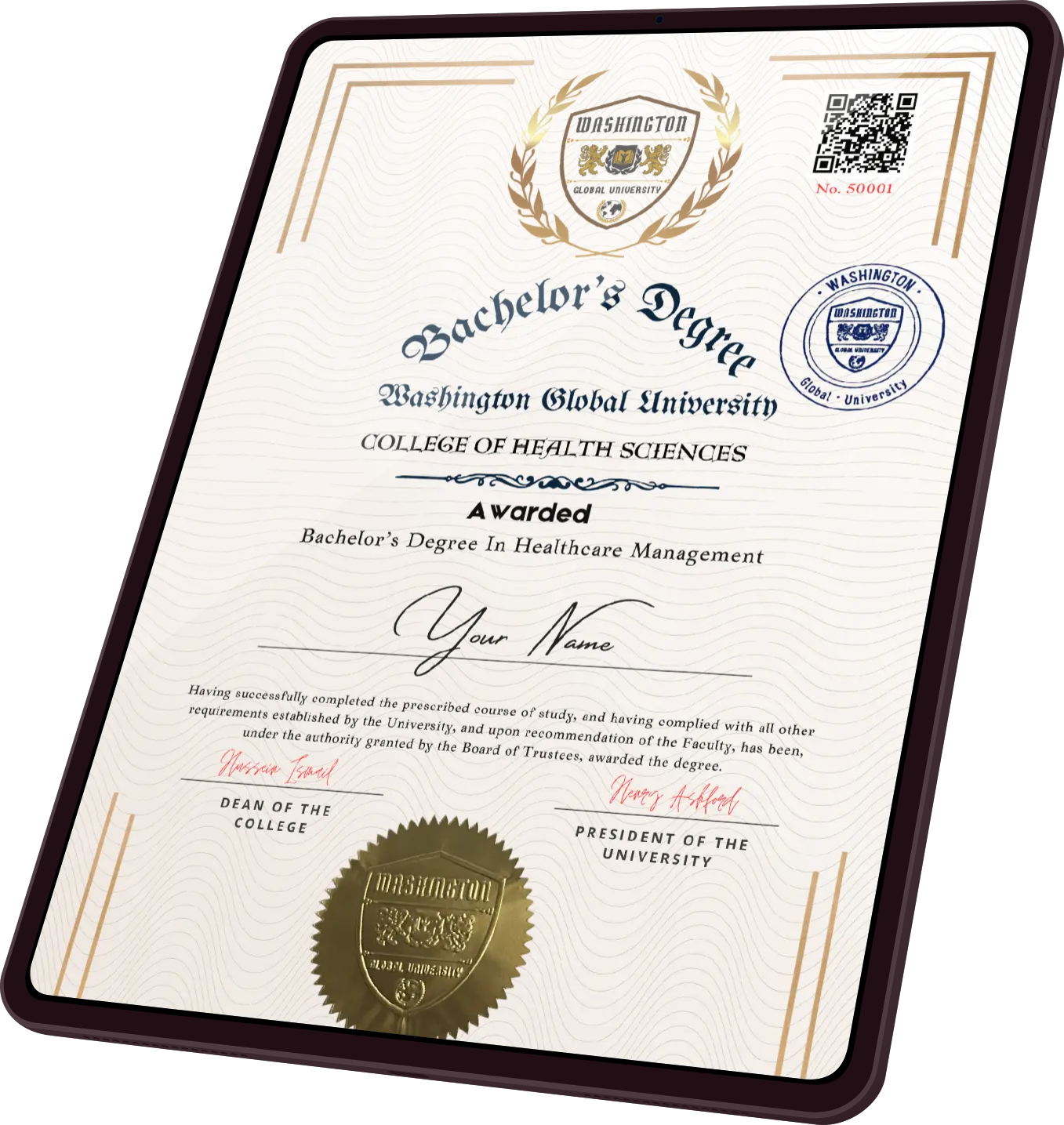
Accredited Bachelor’s Degree Certificate
Graduate with a globally recognized certificate that validates your hard work and success.
Certificate Samples
View sample certificates directly on your student page, giving you a preview of your official credentials.
Accredited Credentials
Why it matters: Having a document notarized makes it more trustworthy and helps prevent fraud, since the notary’s stamp and signature confirm the identity and intent of the signer.
Unlock Accredited Credentials That Open Doors to Opportunity

Notary Public in the United States
A Notary verifies identity , ensures free consent, and certifies valid execution of certificates and documents.
Discover more
Federal Commonwealth Authentication
The Secretary of State’s office verifies that the document was properly notarized or issued by an authorized public official (such as a notary public, county clerk, or registrar). This confirms the document’s legitimacy before it is used abroad.

U.S. Department of State
A signature shows intent, but authentication by the Secretary of State gives your documents unquestionable credibility—transforming personal agreements into legally recognized records trusted at home and abroad.
Continue reading
Embassies & Consulates (if required)
After a document is notarized, authenticated by the Secretary of State, and (if necessary) approved by the U.S. Department of State, the foreign embassy or consulate provides the final legalization. This confirms to the receiving country that the document has been properly verified by all U.S. authorities.
The applicant for the Specialized Bachelor’s Degree receives a scholarship package, which includes:
University Admission Letter
Official confirmation of acceptance into the specialized bachelor’s program.
Accreditation Authority Report
A document verifying that the program meets academic accreditation standards.
Scholarship Certificates
Proof of awarded academic scholarships supporting the student’s study.
Certificates of Excellence and Academic Achievement
Recognition of outstanding performance and scholarly accomplishments.
Scientific Competency Report
An evaluation confirming the applicant’s readiness and qualification for the program.
Scientific Verification Certificate
A document validating the authenticity of the applicant’s academic credentials.
Specialization Course Transcript
detailed record of the courses and subjects covered in the chosen major.
Scientific Membership Card
Identification confirming the applicant’s membership in the academic body.
Scholarship Package in Arabic
A full set of scholarship certificates issued in Arabic for additional recognition
Registration Procedures for the BS in Healthcare Management
Basic Steps for Enrollment at Washington Global University in the United States
- No application fee
- You are 21 years of age or older.
- Complete the application form with your personal and academic information.
- Upload a copy of your educational qualification: High School Diploma (for undergraduate programs).
- Upload a valid proof of identity (Passport – National ID Card – Personal Identification Document).
- Once your application is reviewed, you will be contacted via email.
- An online interview or a written test may be required.
- Receive the official admission letter.
- Pay the tuition fees (either in full or partially, depending on the plan).
- Obtain your login credentials for the online learning platform.
Work one-on-one with an Enrollment Specialist who’ll guide you through every step—from choosing the right program to paying for your education.
- Attend online lectures (live or recorded).
- Submit assignments through the platform.
- Participate in online forums and virtual discussions.
The Future You Envision Is Waiting — Start Building It Today.
Whatever your question is, we’ve got you covered
Whatever your question is, we’ve got you covered.
Washington Global University Enrollment Specialists are trained to help you research, plan, and get started on your academic journey.
Our latest content
Check out what's new in our company !
Discover Your Future — Explore Accredited Degrees Today!
Unlock your global potential with Washington Global University’s fully accredited, embassy-approved degrees—explore your future today!