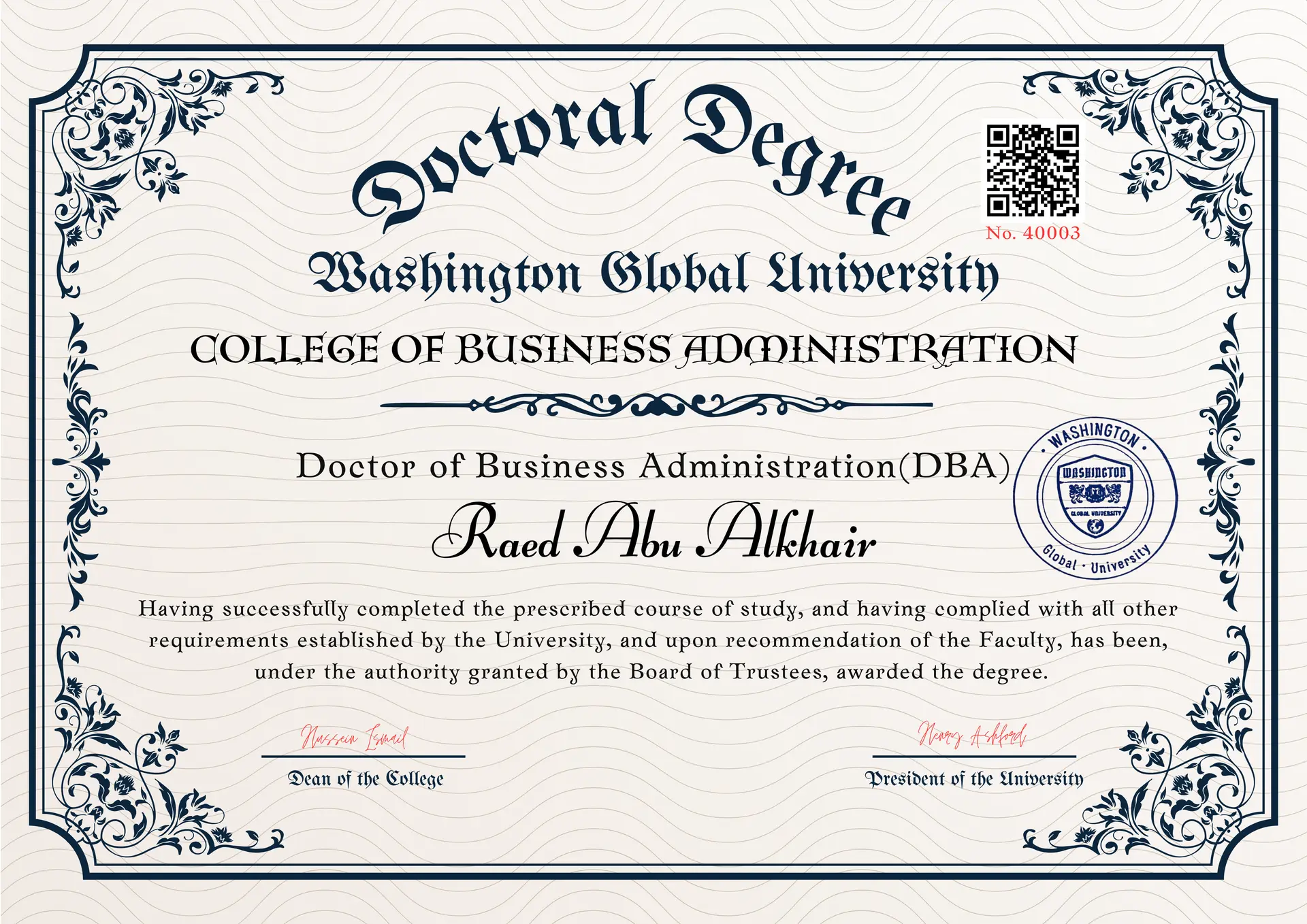
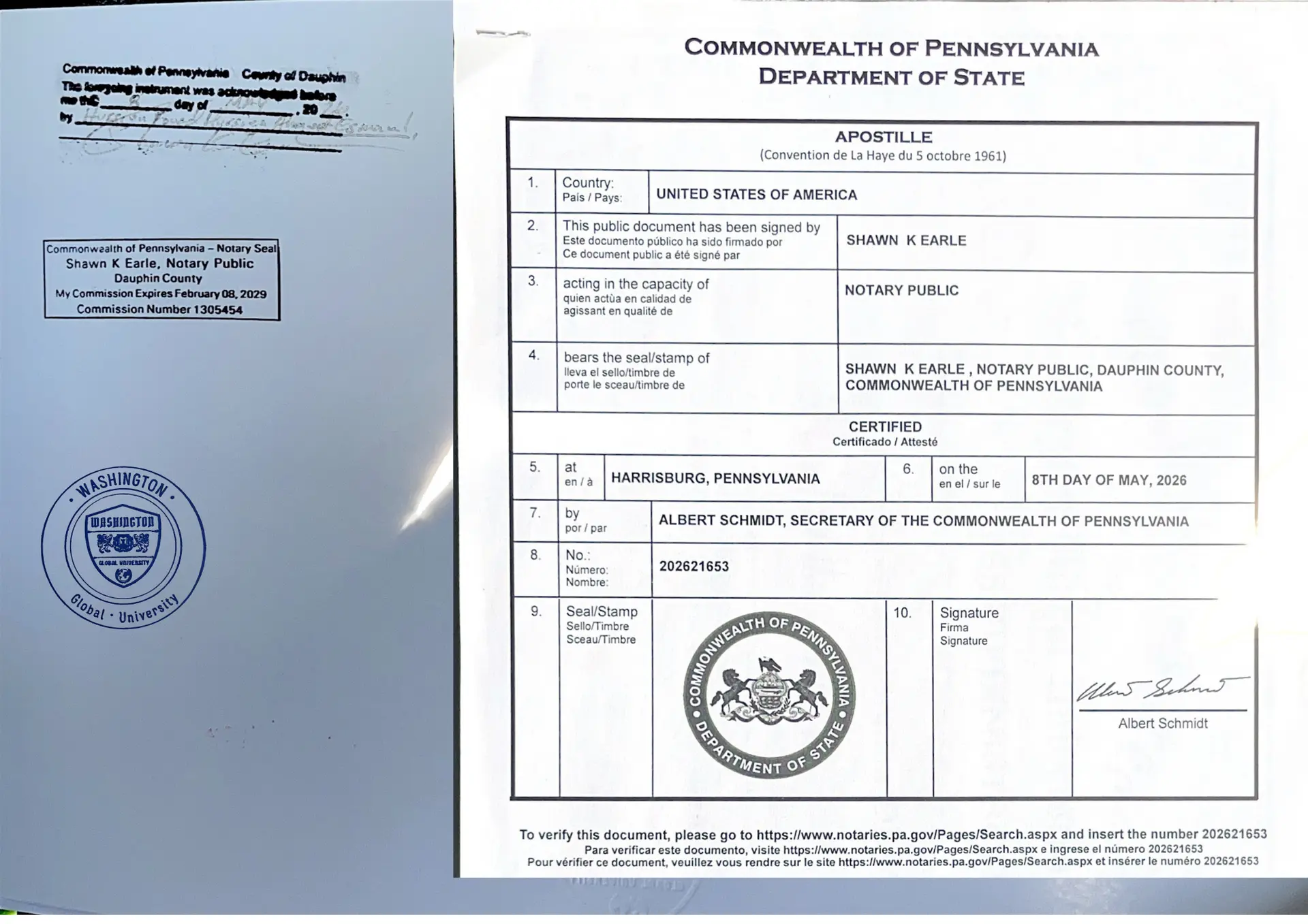
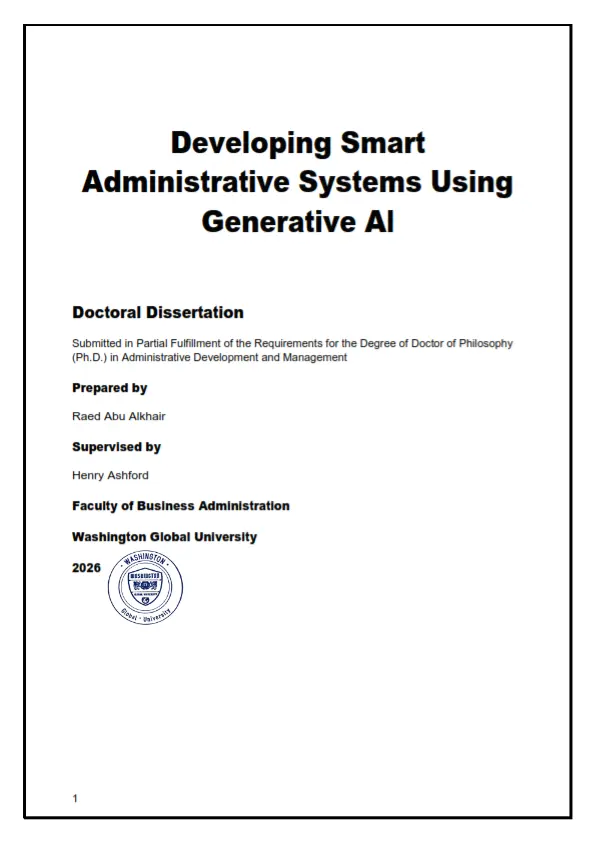
PhD Student Verification Page – Raed Abu Alkhair
Certificate No. 4003


A research journal
Generative AI-Based Smart Administrative Systems and Their Impact on Decision Quality: A Conceptual Framework for Organizational Transformation
Abstract
The rapid development of Generative Artificial Intelligence (Generative AI) is reshaping administrative systems and organizational decision-making processes. Despite increasing adoption of AI technologies, many organizations continue to implement AI solutions in a fragmented manner without an integrated administrative framework capable of maximizing their strategic value. This paper proposes a conceptual framework for Smart Administrative Systems based on Generative AI and examines their impact on improving managerial decision quality. Drawing upon Decision-Making Theory, particularly Herbert Simon's concept of bounded rationality, the study explores how AI-enhanced administrative systems support planning, organizing, directing, and controlling functions through predictive analytics, knowledge management, and intelligent decision support. The proposed framework identifies Smart Administrative Systems as a strategic organizational capability that improves information quality, reduces decision bias, accelerates decision processes, and enhances organizational responsiveness. The study adopts a descriptive-analytical approach and proposes empirical testing through Structural Equation Modeling (SEM). The findings are expected to demonstrate a significant positive relationship between AI-enabled administrative systems and decision quality, while highlighting the importance of governance mechanisms in ensuring responsible and transparent AI adoption.
1. Introduction
Artificial Intelligence has emerged as one of the most influential technologies shaping modern organizations. The increasing complexity of business environments, coupled with the exponential growth of organizational data, has created a pressing need for intelligent administrative systems capable of supporting managerial decision-making. Traditional administrative systems often struggle to process large volumes of information and respond effectively to rapidly changing environmental conditions. Consequently, organizations are increasingly turning to AI-based solutions to enhance operational effectiveness and strategic decision-making.
Generative AI represents a significant advancement in AI capabilities because it can generate content, analyze complex information, provide recommendations, and support managerial activities with minimal human intervention. Its integration into administrative systems has the potential to fundamentally transform organizational processes and improve decision quality across various management levels.
2. Research Problem
Although AI adoption has expanded rapidly, many organizations lack integrated frameworks that define how AI should be embedded within administrative systems. Existing implementations are often isolated and fail to address governance, accountability, transparency, and risk management requirements. Furthermore, excessive reliance on AI may introduce challenges such as algorithmic bias and reduced human oversight, potentially affecting decision quality.
The central research problem is therefore the absence of a comprehensive administrative model that effectively integrates Generative AI into organizational systems while improving decision quality and maintaining responsible governance practices.
3. Research Objectives
This study seeks to:
- Develop an integrated framework for Smart Administrative Systems based on Generative AI.
- Examine the relationship between AI adoption and managerial decision quality.
- Identify organizational and technological requirements necessary for successful implementation.
- Analyze the role of predictive analytics and knowledge management in supporting managerial decisions.
- Explore governance mechanisms that ensure responsible and effective AI utilization.
4. Theoretical Foundation
This study is grounded in Herbert Simon's Decision-Making Theory, which argues that managerial decisions are constrained by limited information, time, and cognitive capacity. AI technologies can help overcome these limitations by providing advanced data analysis capabilities, predictive insights, risk forecasting, alternative scenario evaluation, and automated knowledge generation.
The concept of Hybrid Decision Management further supports the integration of human expertise and AI-driven intelligence to achieve superior decision outcomes.
5. Conceptual Framework
The proposed framework consists of the following constructs:
Independent Variable
Smart Administrative Systems based on Generative AI
Mediating Variables
- Decision Support and Predictive Analytics
- Organizational Knowledge Management
Dependent Variable
Decision Quality
The framework assumes that Generative AI enhances organizational information-processing capabilities, leading to better knowledge generation and more accurate managerial decisions.
6. Impact of Generative AI on Decision Quality
Generative AI contributes to decision quality through several mechanisms:
Information Quality Enhancement
AI systems improve the accuracy, completeness, and timeliness of managerial information.
Predictive Analytics
Organizations can forecast future events, identify risks, and evaluate strategic alternatives before implementation.
Reduction of Human Bias
AI-driven recommendations rely on objective data rather than subjective assumptions, reducing cognitive and organizational biases.
Faster Decision-Making
Automated analytics and report generation significantly shorten the time required to make managerial decisions.
7. Research Methodology
The study adopts a descriptive-analytical methodology combined with a quantitative research approach. Data are collected from managers and employees in organizations utilizing AI technologies.
Data collection methods include:
- Structured questionnaires
- Semi-structured interviews
- Organizational document analysis
Statistical analysis techniques include:
- Descriptive Statistics
- Pearson Correlation Analysis
- Multiple Regression Analysis
- Structural Equation Modeling (SEM)
These methods enable examination of both direct and indirect relationships among the study variables.
8. Expected Findings
The study expects to identify:
- A significant positive relationship between Smart Administrative Systems and decision quality.
- Improved managerial information quality through Generative AI.
- Enhanced efficiency of administrative processes.
- Strong mediating effects of knowledge management and predictive analytics.
- Positive effects of governance mechanisms on AI-supported decision-making.
9. Practical Implications
The proposed framework provides organizations with a roadmap for integrating Generative AI into administrative operations. The findings are expected to help managers improve decision quality, increase operational efficiency, strengthen knowledge management practices, and establish effective governance mechanisms for AI deployment.
Organizations that successfully integrate AI within structured governance frameworks are likely to achieve greater agility, improved performance, and stronger competitive positioning.
10. Conclusion
Generative AI is rapidly becoming a critical component of organizational decision-making infrastructure. Smart Administrative Systems represent a new paradigm in management that combines AI, knowledge management, and predictive analytics to improve decision quality. Organizations that successfully integrate AI within structured governance frameworks are likely to achieve superior managerial performance and enhanced strategic responsiveness. Future empirical studies should validate the proposed framework and explore its applicability across different industries and organizational contexts.